By Staff Writer, John Kling | Updated October 26, 2026
April 27, 2026, Maga Daily News
First Lady Melania Trump
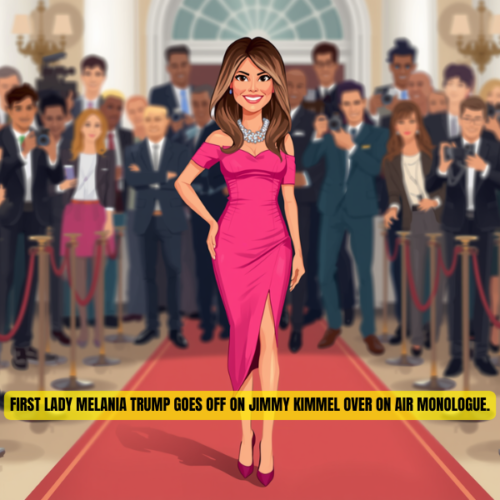
MAGA DAILY NEWS—First lady Melania Trump goes off on Jimmy Kimmel. First Lady Melania Trump took to X (formerly Twitter) to sharply criticize late-night host Jimmy Kimmel, responding to remarks made during his recent monologue about her family. In her post, she described his commentary as divisive and claimed it contributes to political tension in the country.
Melania Trump stated that she believes Kimmel’s words are not comedic in nature and instead have a corrosive effect on public discourse. She also questioned ABC’s decision to continue airing his show, suggesting the network is enabling his behavior by providing him a national platform each night. The comments have sparked renewed discussion online about media responsibility and political commentary in entertainment.
Melania Trump Pushes Back Against Jimmy Kimmel Over Comments About Her Family
Maga Daily News— First Lady Melania Trump has publicly criticized late-night television host Jimmy Kimmel following remarks he made about her family, bringing renewed attention to the ongoing tension between political figures and entertainment personalities. In a post on X, formerly known as Twitter, Melania described Kimmel’s commentary as divisive and argued that his words contribute to political hostility at a time when Americans are already deeply divided. Her response highlights the continuing debate over the boundaries of political comedy, the responsibilities of television personalities, and the role public figures play in shaping national conversations.
Melania Trump Makes Her Position Clear
Melania Trump’s decision to respond publicly demonstrates that she is willing to speak out when she believes commentary about her family crosses a line. As first lady, she occupies a unique position in American public life. Although she is not an elected official, her visibility makes her a frequent subject of media coverage, political discussion, and public criticism.
Her comments directed at Kimmel reflect a broader disagreement over how prominent entertainers discuss the president and his family. Late-night television programs regularly feature political jokes, satirical commentary, and criticism of government leaders. Supporters of these programs often view such material as an important form of free expression, while critics argue that some jokes can become unnecessarily personal or contribute to hostility between Americans.
Melania’s response places her on the side of those who believe public commentary should be considered carefully, particularly when it involves family members and individuals who are already at the center of intense political attention.
Jimmy Kimmel and the Role of Late-Night Comedy
Jimmy Kimmel has built a long-running television career around comedy, celebrity interviews, entertainment news, and commentary on current events. Like other late-night hosts, he frequently incorporates politics into his monologues, using humor to discuss the president, lawmakers, elections, and controversial developments in Washington.Political satire has been a part of American entertainment for generations. Comedians have regularly used their platforms to challenge political leaders, question public decisions, and highlight what they view as contradictions in government. For many viewers, humor offers an accessible way to engage with complicated political issues.
However, political comedy can also generate strong reactions when audiences believe jokes are unfair, disrespectful, or designed to deepen existing divisions. The disagreement between Melania Trump and Kimmel reflects that tension.For some viewers, a comedian criticizing the president is a normal part of public debate. For others, jokes about the president and his family can feel less like political commentary and more like personal attacks. The difference often depends on the audience, the language used, and the circumstances surrounding the remarks.
The Debate Over Political Speech and Personal Attacks
The controversy raises an important question about the distinction between criticizing public officials and making personal remarks about their families. Political leaders are regularly scrutinized because their decisions affect millions of Americans. Their policies, statements, and public conduct are legitimate subjects of discussion and criticism.Family members, however, may experience public attention differently, particularly when commentary moves away from political issues and toward personal characteristics or relationships.As first lady, Melania Trump has her own public responsibilities and initiatives, but she is also a private individual in many aspects of her life. Her public position exposes her to criticism, yet that does not mean every remark about her or her family will be received without objection.
At the same time, comedians and television hosts have broad freedom to express opinions and make jokes, subject to applicable laws and other relevant limitations. The fact that a public figure finds a joke offensive does not automatically mean the comedian has violated a law or crossed a legally defined boundary.The disagreement is therefore largely about judgment, taste, and the responsibilities that accompany a prominent media platform. Americans can support free speech while still believing that certain forms of commentary are unhelpful or unnecessarily inflammatory.
Why the Exchange Matters to Americans
The public disagreement between Melania Trump and Kimmel is part of a larger conversation about political polarization in the United States. Political differences increasingly influence how people consume news, evaluate entertainment, and interpret statements from public figures.A joke that one audience considers harmless may be viewed by another as disrespectful or hostile. Similarly, a sharp response from a political figure may be welcomed by supporters as a defense of personal dignity while being criticized by opponents as an attempt to discourage unfavorable commentary.These competing reactions demonstrate how difficult it can be for public figures to communicate across political lines.
Television personalities have the ability to reach large audiences, and their comments can quickly spread beyond the original broadcast through social media clips and online discussions. Political figures have similar opportunities to communicate directly with supporters without relying entirely on traditional news organizations.Melania’s use of X illustrates how social media has changed the relationship between public officials, entertainers, and the public. Rather than allowing a television monologue to stand on its own, a public figure can respond immediately and present a different interpretation of the exchange.That response can generate another round of headlines, reactions, and debate, sometimes extending a controversy far beyond the original remarks.
Social Media Adds Fuel to the Conversation
Social media platforms have become central to modern political disagreements because they allow statements to circulate rapidly among millions of users. Supporters and critics can react within minutes, often sharing selected portions of a statement rather than watching or reading the complete exchange.
This speed can make it difficult for audiences to distinguish between the original remarks, a public figure’s interpretation, and commentary added by other users.
In a dispute involving a first lady and a nationally recognized television host, the competing reactions are likely to reflect broader political loyalties as well as individual opinions about comedy and public conduct.
Some users may applaud Melania for speaking out against what she considers divisive rhetoric. Others may defend Kimmel’s ability to use satire to criticize the president and those connected to his administration.
Neither reaction necessarily represents the views of the entire country. Online discussions can make disagreements appear more universal than they actually are, particularly when highly emotional posts receive substantial attention.
For readers following the controversy, reviewing the original statements and considering the context is more useful than relying exclusively on headlines or short social media clips.
Free Speech and Responsibility Can Coexist
The disagreement also provides an opportunity to consider how free expression and personal responsibility can coexist in a democratic society.
The First Amendment protects a broad range of political speech and commentary from government interference. Comedy, satire, and criticism of public officials receive substantial protection under American law.
That protection does not require audiences to approve of every joke or public statement. People remain free to criticize comedians, question their judgment, express disagreement, and decide which programs they want to watch.Likewise, public figures can challenge commentary they believe is unfair without necessarily seeking to silence the people making it.
The strongest public debates allow competing viewpoints to be expressed and evaluated on their merits. Disagreement does not have to lead to personal hostility, and criticism does not automatically have to be interpreted as an attack on an entire political group.
Whether viewers agree with Melania Trump or Jimmy Kimmel, the exchange illustrates the continuing challenge of maintaining meaningful public discussion in an environment where political disagreements can quickly become personal.
What Happens Next?
The dispute places renewed attention on the relationship between the Trump family and late-night television, where political jokes and public responses have repeatedly become subjects of national discussion.
Whether the exchange leads to additional comments from either side remains to be seen. Any further developments will depend on what the participants say and how the story continues to unfold.
For now, the disagreement underscores how entertainment and politics have become increasingly intertwined. Television hosts use their programs to comment on political events, while public officials and their families use social media to challenge coverage and defend their positions.
Ultimately, Americans can decide for themselves whether Kimmel’s remarks were appropriate and whether Melania’s response was justified. The important distinction is between reporting what was said, understanding the context, and forming an opinion based on the available information.
The controversy serves as another reminder that public speech carries influence, but the public also has the right to disagree with those who use it. In a country with sharply different political perspectives, the challenge is not eliminating disagreement. It is ensuring that disagreements can be expressed openly without turning every dispute into another reason for Americans to divide themselves further.
Disclaimer: This information is based on current reports and is for informational purposes only. The photo illustration and text caption are AI generated. We represent M.A.G.A. — Morals ● Action ● God ● America—Maga Daily News., an online faith based news editorial.