By Staff Writer, Oakley Kate
October 14, 2026, M.A.G.A. Daily News
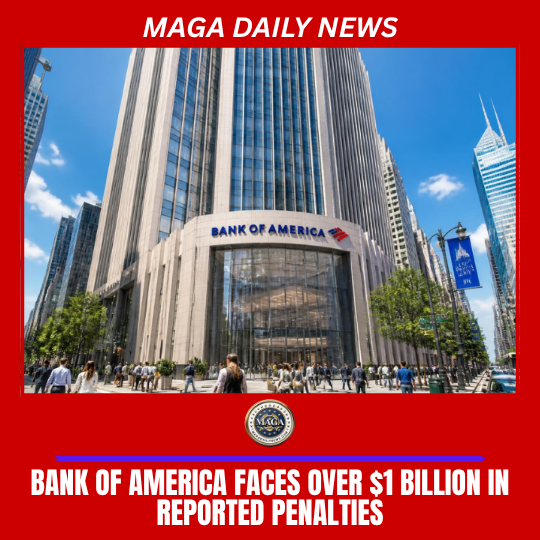
Bank of America Faces More Than $1.2 Billion in Federal Penalties Over Financial Monitoring Failures
Maga Daily News— Bank of America, one of the largest financial institutions in the United States, is facing more than $1.21 billion in federal penalties following enforcement actions announced by the U.S. Department of the Treasury on October 13, 2026. Federal regulators say the bank failed to properly identify, investigate, and report billions of dollars in suspicious financial activity. The case also includes a separate settlement involving apparent violations of U.S. sanctions. The penalties raise important questions about bank oversight, financial accountability, and the safeguards designed to protect the American financial system.
This is not the first time B of A has had their hand slapped about 12 years ago they faced $17 Billion in fines. Personal experiences with B of A include over charging fee’s based on funds less than a dollar in a checking account. They were sued nearly 20 years ago and settled the case of allegedly overcharging fee’s. Then back in the day there was the Robo signatures on home loans where B of A lost big time over their nonsense.
Federal Officials Detail the Alleged Failures
According to the Treasury Department, Bank of America failed to report more than $5 billion in suspicious transactions to the Financial Crimes Enforcement Network, known as FinCEN, in a timely manner. Officials said more than $1 billion of that activity involved national security concerns and other high-priority financial risks. The reported concerns included possible links to Chinese money-laundering networks, fraud, and suspicious trade-related transactions connected to the U.S. southwest border. These findings concern the bank’s handling of suspicious activity reports; they do not mean that every transaction involved criminal conduct.
Federal rules require banks to maintain systems that help identify activity that may involve money laundering or other financial crimes. When a bank detects transactions that raise certain concerns, it may have a legal duty to investigate and submit a suspicious activity report to federal authorities. These reports can help investigators identify patterns, connect information from different sources, and determine whether further action is needed. They are not, by themselves, proof that a customer committed a crime.
Why Suspicious Transaction Reports Matter
Money laundering involves moving money through financial transactions in ways intended to hide its criminal source or ownership. Criminal networks may attempt to move funds through multiple accounts, businesses, or countries to make the activity harder to trace. Banks play an important role in helping authorities spot warning signs and report activity that meets federal reporting requirements.
The purpose of these rules is not to treat every unusual payment as criminal. People and businesses make legitimate transactions that can be large, complicated, or unexpected. Instead, banks are expected to use appropriate monitoring systems, review warning signs, and report suspicious activity when the law requires it. Investigators can then examine the information alongside other evidence.
The Treasury Department said Bank of America relied too heavily on outside referrals, including inquiries from law enforcement and information from other financial institutions, rather than using effective internal systems to identify suspicious transactions. Regulators also reported that some activity remained uninvestigated for extended periods, leading to late reports that were less useful to investigators.
How the Penalties Add Up
The federal action involves several enforcement measures. FinCEN assessed a $1.2 billion penalty related to the bank’s failure to address and report high-priority financial risks. The Office of the Comptroller of the Currency, which supervises national banks, also assessed a $750 million civil money penalty. That amount was described by the agency as the largest penalty in its history.
The $750 million assessment is credited toward the larger FinCEN penalty, so it should not be added to the $1.2 billion figure as though the bank must pay both amounts in full. The overall enforcement actions total more than $1.21 billion when the separate sanctions settlement is included.
The Treasury Department’s Office of Foreign Assets Control also announced an $11.6 million settlement involving apparent violations of several U.S. sanctions programs. Those programs include restrictions related to Iran, Russia, narcotics, and global terrorism. Sanctions can limit financial dealings with certain countries, organizations, businesses, or individuals. Banks are expected to maintain controls that help them follow these restrictions.
Together, the measures represent one of the largest federal penalties of their kind. The Treasury Department described the main penalty as the third-largest in its history.
A Previous Regulatory Order Adds to the Scrutiny
The case also follows an earlier regulatory action. According to the Office of the Comptroller of the Currency, Bank of America was already subject to a December 2024 cease-and-desist order requiring improvements to its anti-money-laundering compliance program. Regulators said serious weaknesses remained after that order was issued.
The latest action highlights why financial regulators pay attention not only to whether a bank has written policies, but also to whether those policies work in practice. A bank may have monitoring software, compliance employees, and internal review procedures, yet still face regulatory action if those systems do not identify and escalate suspicious activity effectively.
Federal officials said the bank’s monitoring systems failed to properly review transactions involving trillions of dollars in financial activity. That does not mean trillions of dollars were found to be criminal. Rather, regulators said the monitoring weaknesses affected the bank’s ability to identify and report potentially suspicious transactions within the required time.
The new enforcement measures also require additional work to review past activity and improve the bank’s compliance systems. An independent third party will help examine transactions that may have been missed and assess important parts of the bank’s monitoring and reporting programs.
What Bank of America Says
Bank of America responded by saying it had worked with regulators to resolve the enforcement matters. The bank said it has invested billions of dollars in technology and dedicated thousands of employees to combating financial crime. It also stated that it is committed to completing the work required to address the problems raised by regulators.
The bank’s response is an important part of the story because the enforcement actions involve both the regulators’ findings and the bank’s stated efforts to correct its systems. The required reviews and improvements will help determine whether the bank’s monitoring, customer checks, and reporting procedures meet federal expectations going forward.
What the Case Means for Customers and the Banking Industry
The penalties do not automatically mean that ordinary Bank of America customers have done anything wrong, nor do they establish that every transaction identified by regulators involved illegal activity. The central issue is whether the bank met its legal responsibilities for monitoring financial activity, investigating warning signs, and reporting concerns to federal authorities.
For customers, the case is a reminder that banks operate under rules intended to protect the financial system and help prevent criminal networks from moving money unnoticed. For the banking industry, it sends a strong message that large institutions are expected to maintain effective controls and respond to regulatory warnings.
The case also shows that compliance failures can carry substantial financial costs, particularly when regulators believe problems continued despite earlier orders. The independent reviews and corrective measures will be important steps in determining whether the identified weaknesses are addressed.
The broader question is whether financial institutions are doing enough to identify suspicious activity before it becomes a larger problem. Federal officials say effective monitoring is essential to protecting national security and the integrity of the U.S. financial system. For Bank of America, the next challenge will be demonstrating that its systems can meet those responsibilities consistently.
Disclaimer: This information is based on current reports and is for informational purposes only. The photo illustration and text caption are AI generated. We represent M.A.G.A. — Morals ● Action ● God ● America—M.A.G.A., an online daily faith based news editorial.