By Staff Writer, Oakley Kate
October 9, 2026, M.A.G.A. Daily News
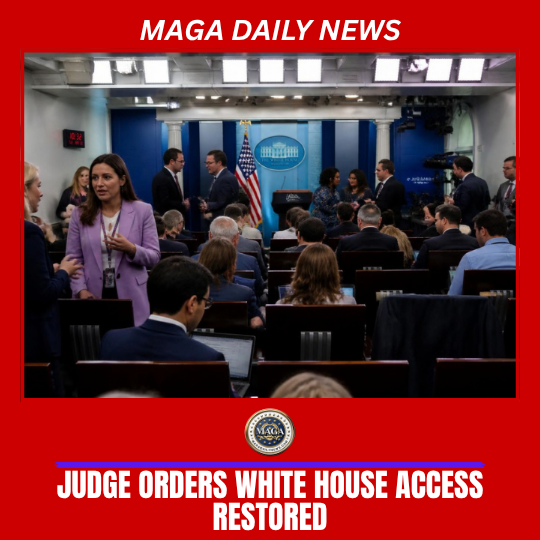
Federal Judge Orders Trump Administration to Restore White House Press Access
Maga Daily News— A federal judge has ordered the Trump administration to restore White House press credentials for CNN, MS NOW, and Politico while a court case over media access continues. U.S. District Judge Timothy Kelly issued a temporary restraining order requiring officials to return the outlets’ access passes. The order is set to remain in effect for 14 days. The ruling brings fresh attention to an important question: how much control should the White House have over which news organizations can cover the president? The leftist would have you believe there is the nothing the President can do to prohibit them from attending. Far from the truth, the President can in a heart beat second ban them for any national security reason. Let’s stop the lying.
What Led to the Judge’s Decision?
The dispute began after President Donald Trump’s administration restricted White House access for three news organizations: CNN, MS NOW, and Politico. Trump had criticized the outlets’ reporting, accusing them of publishing false information. The administration’s decision led to a legal challenge over whether the White House had acted within its authority when limiting their access.
Press credentials allow approved journalists to enter designated areas and cover government officials and events. These credentials are an important part of daily political reporting because they help reporters attend briefings, ask questions, and share information with the public.
When access is restricted, news organizations may have a harder time gathering information directly from government officials. That can affect how quickly they report on announcements, policy decisions, and other developments coming from the White House.
What Did the Federal Judge Order?
U.S. District Judge Timothy Kelly issued a temporary restraining order directing the administration to restore the affected news organizations’ White House press credentials. The order requires officials to return, reinstate, and restore the access passes while the legal proceedings continue.
A temporary restraining order is a short-term court measure. It is designed to address a situation while the court considers the legal questions involved. It does not necessarily settle the entire case or determine what the final outcome will be.
In this situation, the order gives CNN, MS NOW, and Politico temporary relief while the dispute moves forward. It also places limits on the administration’s ability to maintain the restrictions covered by the judge’s decision during the order’s effective period.
The 14-day period is important because it creates a limited window for the parties and the court to address the next steps. Further court action could clarify how the restrictions will be handled after that period.
Why White House Press Access Matters
The White House is one of the most important centers of government in the United States. Decisions made there can affect families, businesses, national security, taxes, and many other parts of American life.
Journalists help the public understand those decisions by attending briefings, asking questions, reviewing official statements, and reporting on government actions. News organizations may disagree strongly with the president or his policies, but their ability to gather information remains an important part of the national news process.
White House access does not mean that a news organization has the right to enter every room or attend every event. Officials can establish security rules, manage limited space, and set reasonable procedures for press coverage. The legal question is whether a particular restriction follows the law and respects the rights that apply in that situation.
That distinction matters. A government office needs workable rules, but those rules can also face legal challenges if journalists believe they have been treated unfairly or that their rights have been violated.
The Administration’s Position and the Legal Questions
The Trump administration has defended its position on press access, arguing that the White House has authority to manage access to its facilities and determine how certain press activities are organized. The Justice Department’s arguments are part of the broader legal dispute over the administration’s decision.
At the center of the case is the relationship between government authority and the protections that apply to news reporting. The administration must be able to manage the White House, while journalists and media organizations may challenge decisions they believe violate applicable legal protections.
Courts consider the facts, the arguments presented by both sides, and the laws that apply. The judge’s temporary order does not automatically mean that every argument made by the news organizations has been accepted. It also does not mean the administration has lost the entire case.
Instead, the order establishes a temporary requirement while the legal process continues. The final outcome will depend on the proceedings and any further decisions issued by the court.
The First Amendment and Freedom of the Press
The First Amendment to the U.S. Constitution protects freedom of speech and freedom of the press. These protections play a central role in how Americans receive information and discuss government decisions. We’re talking about the White House, not a corner store, it is a priviledge nor a right to attend such briefings. Karoline Leavitt, former Press Secretary who appeared to be well taken by all forms of storytellers but recently left to in part take a new position with FOX news as a contributor.
However, the First Amendment does not give every journalist unlimited access to every government building or event. Courts must consider the specific circumstances, the rules involved, and whether the government’s actions are consistent with the law.
This is why disputes over press credentials can become complicated. The question is not simply whether a president likes a particular news outlet. It is whether the government’s decision complies with the legal standards that apply to access, official facilities, and press coverage.
The case involving CNN, MS NOW, and Politico highlights how these questions can reach federal court. It also shows why temporary court orders can matter when a dispute involves access to an important government institution.
What Happens After the 14-Day Order?
The temporary restraining order is limited in duration, so the next steps in the case are important. The court may consider additional arguments, review further filings, or issue another order explaining how the dispute should proceed.
Depending on the court’s decisions and the applicable procedures, the temporary restrictions on the administration’s actions could be extended, changed, or replaced by another ruling. The parties may also continue arguing over the broader legal questions.
Readers should distinguish between what the judge has ordered so far and what may happen later. The current order addresses press access during a limited period. It should not be treated as a final ruling on every issue raised in the case.
Any later decision could provide more detail about the limits of the administration’s authority and the rights claimed by the news organizations. Until then, the legal process remains an important part of the story.
Why Americans Should Pay Attention
This case raises questions that reach beyond the three news organizations involved. It concerns how government officials manage access for journalists and how courts review decisions that are challenged under the law.
People may have strong opinions about CNN, MS NOW, Politico, or the Trump administration. Those opinions can differ based on political beliefs and trust in the media. But the legal issues can still matter to Americans who follow different news sources or hold different political views.
A healthy public discussion depends on understanding what has actually happened, what each side argues, and what the courts have decided. It is equally important to avoid treating a temporary ruling as the final word before the legal process has concluded.
The judge’s order is a significant development in the ongoing dispute, but it is not the end of the story. The next court actions will help determine how the matter moves forward.
For now, the administration has been ordered to restore the affected press credentials while the case continues. The coming legal proceedings may offer a clearer picture of how White House press access will be handled and what limits apply to government decisions involving news organizations.
Disclaimer: This information is based on current reports and is for informational purposes only. The photo illustration and text caption are AI generated. We represent M.A.G.A. — Morals ● Action ● God ● America—M.A.G.A., an online daily faith based news editorial.