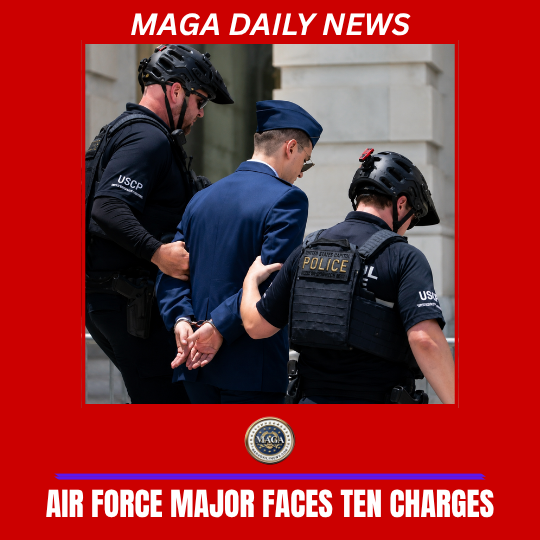
Air Force Major Jason Watson is now facing 10 charges under the Uniform Code of Military Justice. The charges stem from his public criticism of President Donald Trump, including a July 1 appearance at the U.S. Capitol while wearing his Air Force uniform and holding an “IMPEACH CONVICT REMOVE” sign, followed by an August 17 CNN interview.
According to the charging document, he faces three Article 88 charges for alleged contemptuous remarks, five Article 92 charges for allegedly disobeying orders, and two Article 133 charges for alleged conduct unbecoming an officer. Maga Daily News supports the U.S. Military to the fullest extent but there are boundries.
Air Force Major Jason Watson Case Raises Questions About Military Rules
The case involving Air Force Major Jason Watson has quickly become a major national story. Watson, an active-duty officer with 17 years of military service, is facing 10 charges under the Uniform Code of Military Justice after publicly criticizing President Donald Trump and taking part in political activity while wearing his military uniform. The charges include three counts under Article 88, five under Article 92, and two under Article 133.
The Capitol Demonstration
The controversy began on July 1, 2026, when Watson appeared at the U.S. Capitol wearing his Air Force uniform. He stood on the Capitol steps holding a sign that read “IMPEACH CONVICT REMOVE.” Watson was calling for the removal of President Trump and Vice President JD Vance.
Capitol Police detained Watson after he remained on the House steps without a member of Congress accompanying him. Video from the incident showed officers escorting him away from the steps. His civilian case connected to that incident was later dropped, but the military investigation continued.
Why The Uniform Matters
Military members have constitutional rights, including freedom of speech. However, active-duty service members also operate under a separate system of military rules. Those rules place limits on certain political activities, especially when a service member is wearing a military uniform.
The basic concern is maintaining a clear separation between personal political opinions and the official military institution. When someone speaks publicly while wearing a military uniform, viewers may believe that person is speaking as part of the armed forces rather than only as an individual.
That distinction is now at the center of the Watson case.
Ten Charges Filed
Military authorities have formally brought 10 specifications against Watson. Three involve Article 88, which concerns contemptuous words toward certain senior government officials. Five involve Article 92, which concerns alleged violations of orders or regulations. Two involve Article 133, which concerns alleged conduct unbecoming an officer.
The Article 88 allegations reportedly involve statements made during interviews and public appearances. The Article 92 allegations involve claims concerning political activity, military regulations, travel and orders involving his uniform.
The charges are allegations. They do not mean Watson has been found guilty.
A Rare Military Law Case
One of the most closely watched parts of the case is Article 88. The provision has been used relatively rarely, making the charges against Watson especially notable.
The case could receive attention from military members, legal experts and commanders across the country. Many will be watching how military authorities handle the case and what legal questions could emerge from the proceedings.
The case may also raise questions about how military regulations apply when an active-duty officer becomes involved in highly visible political activity.
Watson’s Legal Fight Continues
Watson has not been convicted of any offense. He remains entitled to due process throughout the military justice process.
The case could have serious consequences for his military career if the allegations are ultimately proven. Possible outcomes in military cases can vary depending on the charges, evidence and decisions made throughout the legal process.
For now, the case remains ongoing.
A Larger Debate About Military Service
The Watson case has opened a much larger debate about military service, political speech and individual rights.
Service members are American citizens with their own political beliefs. They do not lose their basic rights simply because they serve in the military.
At the same time, military service comes with additional responsibilities and rules. Officers are expected to follow regulations and protect the public’s confidence in the armed forces.
That balance is now being tested in the Watson case.
What Happens Next Could Matter
The next stages of the case could receive significant attention. Military officials will continue working through the charges and the legal process will determine what happens to Watson.
The outcome could become an important example of how the military handles political expression by an active-duty officer.
Regardless of political views, the case raises an important question: Where should the line be drawn between an individual’s right to speak and the responsibilities that come with wearing the uniform?
That question is likely to remain at the center of the Watson case as the proceedings continue.
Takeaway: Military service comes with rules, even when politics gets heated. This case could have major consequences for military members and public political activity.
⚖️ Sources
- United States Air Force
- Uniform Code of Military Justice
- CNN
- Reuters
- CBS News
⚠️ Disclaimer: This information is based on current reports and is provided for informational purposes only. The charges are allegations and do not establish guilt. The photo and text caption are AI generated.